Validation, with the differences stated.
A comparison with another simulation shows that the two programs solve the same equations alike; only measurements show that both describe the real muffler.
SpectraSim is checked against measurements, exact or analytical solutions and a commercial finite-element code. Against measured transmission loss of concentric-tube resonators (Sullivan and Crocker, 1978), peak levels agree within about 2 dB. Against a commercial finite-element code on a muffler with an extended-tube chamber, the TL rms difference is 0.12 dB. The acceptance criterion against measurement is ±3 dB.
How accurate is SpectraSim against measurement, theory and other codes?
Acceptance criterion for acoustics against measurement: within ±3 dB over the frequency range of the measurement; flow results are compared case by case as stated.
Acoustics: finite elements, frequency domain
| Case | Reference | Result |
|---|---|---|
| Muffler with an extended-tube chamber, 20 °C, 20–1000 Hz | Code-to-code the same model in a commercial finite-element code | transmission loss rms 0.12 dB, largest 1.3 dB; the 815 Hz notch at the same frequency |
| Two-inlet muffler with eight internal walls, 450 °C, 20–500 Hz | Code-to-code commercial finite-element code | median 0.9 dB, rms 3.2 dB; the sharp notches (65 dB) carry the largest differences; the reference mesh's convergence is not known |
| Large exhaust muffler with three absorbing-material regions, 20–500 Hz | Code-to-code commercial finite-element code, its finest mesh | rms 0.16 dB, median 0.04 dB, largest 0.49 dB |
| Concentric-tube resonators (Sullivan and Crocker, 1978) | Measured measured transmission loss | main peak 7–10 % lower in frequency than measured, peak levels within about 2 dB; humps within 1 dB |
| Parallel-baffle (splitter) silencer, mineral fibre with a porous foil cover, 50–4000 Hz | Measured measured transmission loss (Mechel, Formulas of Acoustics, 2008, J.22) | rms 1.37 dB, largest 2.94 dB; all bands from 100 Hz to 4 kHz within ±3 dB; the 630 Hz peak reproduced |
| Pod silencer with absorbing pod and lining (Munjal, 2003), 20–5000 Hz | Analytical the paper's bulk-reacting plane-wave theory, solved again with the same inputs | absorbing section rms 1.3 dB, largest 2.3 dB below the 1.7 kHz cut-on; the paper's printed curve is matched below 1 kHz (rms 2.9 dB) and lies 7–13 dB lower above it, most likely an unreported protective perforate |
| Double-plug muffler with mean flow, 0.0556 kg/s | Other reference reference curve supplied with the model (source not yet identified) | rms 2.5–3.0 dB depending on the perforate model; about +3 dB at 300–900 Hz, most likely the missing mean-flow convection in the duct |
| Straight duct, expansion chamber | Analytical exact one-dimensional solutions | duct: |T| = 1.0000; chamber: within 0.36 dB below 0.4 of the first cross-mode cut-on, the rest is the known limit of the 1-D theory |
| Straight pipe with radiation domains | Analytical analytic power | insertion loss within 0.0006 dB |
Flow and heat transfer: OpenFOAM, steady RANS k-ω SST
| Case | Reference | Result |
|---|---|---|
| Turbulent pipe flow, Re 10⁴ | Other reference published validation of a commercial CFD service (friction factor 0.0309) | pressure drop +9.7 % (entrance region of a uniform-inlet pipe against a developed-flow reference) |
| 90° pipe elbow, water | Code-to-code commercial finite-element CFD model (405 Pa between two planes) | +8 % with the less diffusive momentum scheme on the same mesh (+18 % with the default scheme) |
| Symmetric Y-splitter | Symmetry symmetry | flow split 50/50 within 1 % |
| Transient against steady, coarse pipe | Self-consistency the steady result | 14.2 Pa against 15.4 Pa |
| Insulated hot pipe, 700 K | Analytical analytical heat-transfer correlations | temperature drop within 2.8 % (cylindrical reference); energy balance 0.017 % |
Tables reproduced verbatim from the program's validation summary, SpectraSim 0.6.0a1. Each row has a stable link (for example #tl-sullivan-crocker). The same rows as data: validation results in JSON.
Which cases show SpectraSim's accuracy best?
The muffler and the curves behind each number: two measured, two analytical and two code-to-code comparisons. Open a case for its model, set-up and plots.
-
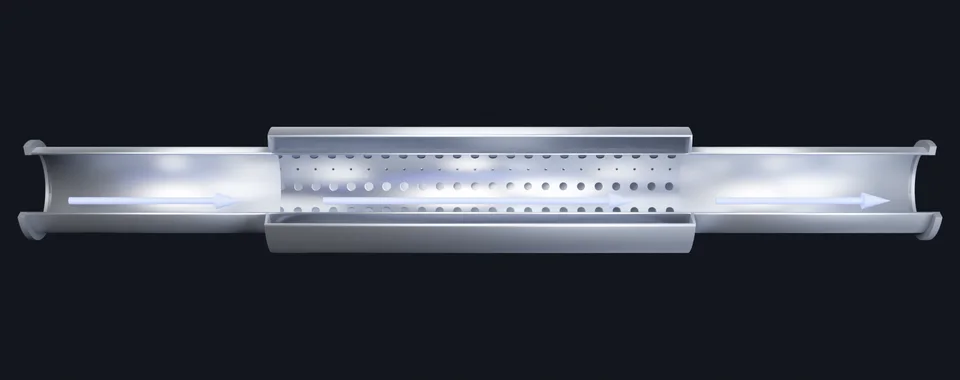 Measured
Concentric-tube resonators
≈ 2 dB peak levels against measuredAgainst measured transmission loss, for the concentric-tube resonators (Sullivan and Crocker, 1978), SpectraSim gives: main peak 7–10 % lower in frequency than measured, peak levels within about 2 dB; humps within 1 dB.
Model and curves -
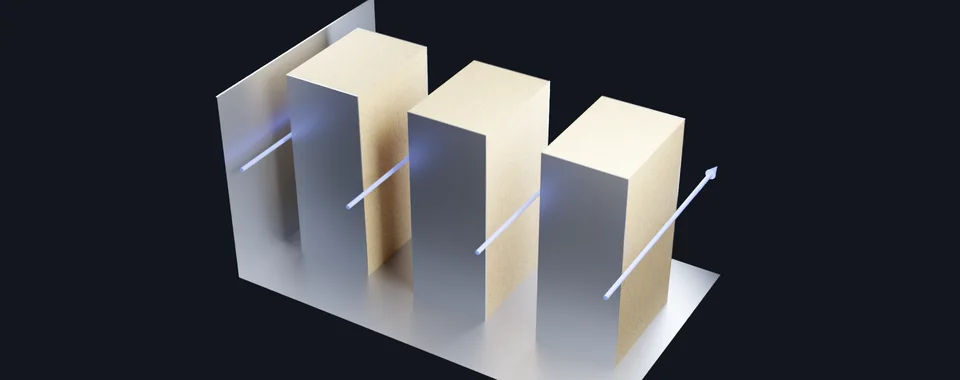 Measured
Parallel-baffle (splitter) silencer
1.37 dB TL rms difference, 50 Hz to 4 kHzAgainst measured transmission loss (Mechel, Formulas of Acoustics, J.22), for the parallel-baffle (splitter) silencer, mineral fibre with a porous foil cover, 50–4000 Hz, SpectraSim gives: rms 1.37 dB, largest 2.94 dB; all bands from 100 Hz to 4 kHz within ±3 dB; the 630 Hz peak reproduced.
Model and curves -
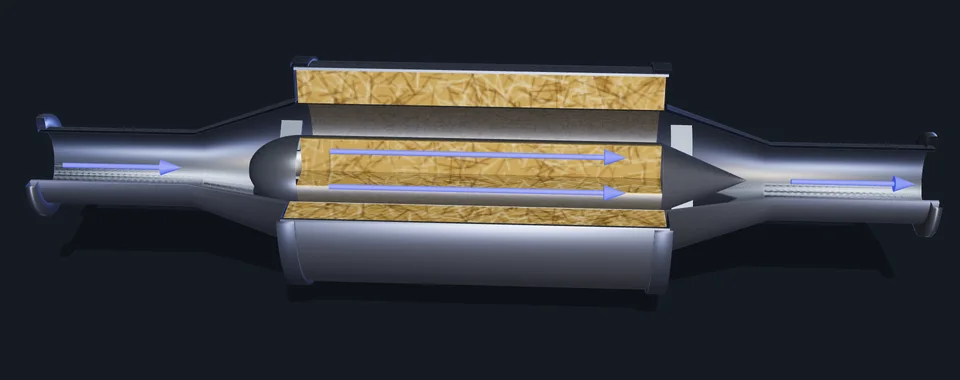 Analytical
Pod silencer with absorbing pod and lining
1.3 dB TL rms difference below the 1.7 kHz cut-onAgainst the paper’s own plane-wave theory (Munjal, 2003), solved again with the same inputs, for the pod silencer with absorbing pod and lining (Munjal, 2003), 20–5000 Hz, SpectraSim gives: absorbing section rms 1.3 dB, largest 2.3 dB below the 1.7 kHz cut-on; the paper's printed curve is matched below 1 kHz (rms 2.9 dB) and lies 7–13 dB lower above it, most likely an unreported protective perforate.
Model and curves -
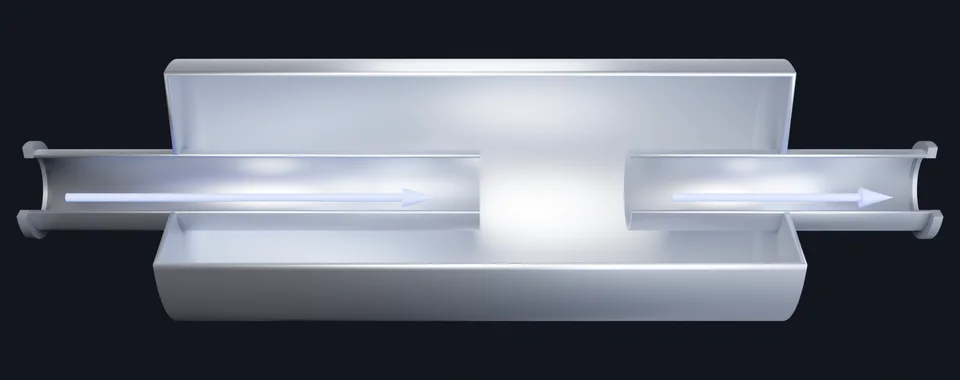 Code-to-code
Muffler with an extended-tube chamber
0.12 dB TL rms difference, 20 Hz to 1 kHzAgainst the same model in a commercial finite-element code, for the muffler with an extended-tube chamber, 20 °C, 20–1000 Hz, SpectraSim gives: transmission loss rms 0.12 dB, largest 1.3 dB; the 815 Hz notch at the same frequency.
Model and curves -
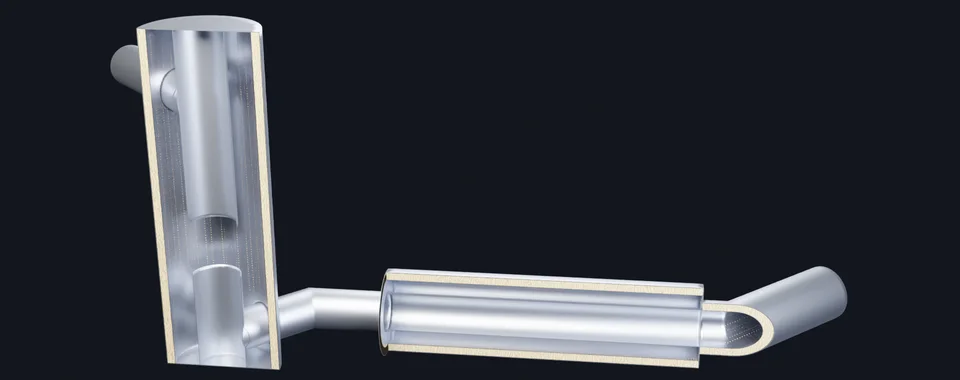 Code-to-code
Exhaust muffler with three absorbing packings
0.16 dB TL rms difference, 20 to 500 HzAgainst a commercial finite-element code on its finest mesh, for the large exhaust muffler with three absorbing-material regions, 20–500 Hz, SpectraSim gives: rms 0.16 dB, median 0.04 dB, largest 0.49 dB.
Model and curves -
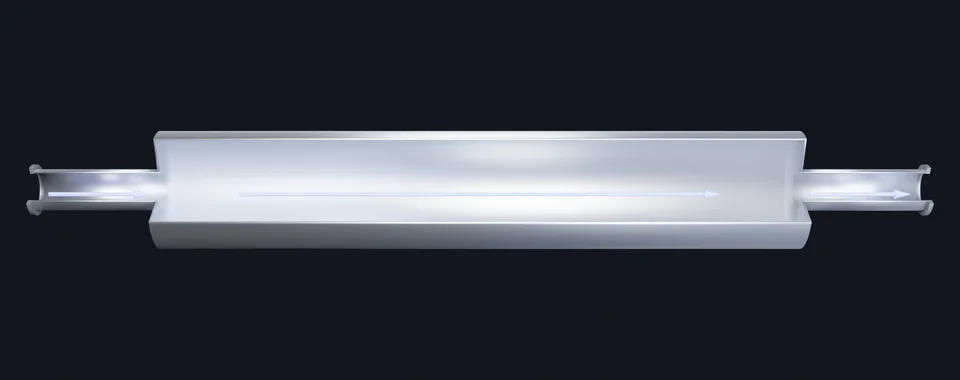 Analytical
Expansion chamber against the exact 1-D solution
0.36 dB below 0.4 of the first cross-mode cut-onAgainst exact one-dimensional solutions, for the straight duct, expansion chamber, SpectraSim gives: duct: |T| = 1.0000; chamber: within 0.36 dB below 0.4 of the first cross-mode cut-on, the rest is the known limit of the 1-D theory.
Model and curves
What has not been verified yet?
| Feature | Verification | Checked so far | Still missing |
|---|---|---|---|
| Compressible flow with the transonic solver | Not verified | Re-run with the crash fixed and again from a settled start, on a strongly compressible muffler: stable, but it does not converge. | A converged solve. |
| Compressible flow with the pseudo-transient (local time-step) solver | Not verified | Re-run with the changed settings on the same muffler: stable, but not converged after 600 iterations; the mass balance is still several per cent off. | A converged solve. |
| Mean-flow convection in the acoustic solve | Not verified | Runs on a real muffler at low Mach number, where the TL moves by hundredths of a dB. An error was found in the insertion loss with convection, so insertion loss and radiated sound are switched off when it is on. | A comparison with a measured TL with flow. |
| Insertion loss with a radiation domain at the outlet | Partly checked | Agrees with the analytic baffled piston; run on a real muffler, where it matches the flanged-pipe end below its switch frequency. | A comparison with a measured insertion loss. |
| JCA / JCAL absorbing-material models | Partly checked | Agrees with measured foam absorption; a full acoustic run of a packed resonator stays within about 1 dB of the Miki model below 1 kHz. | A full run against a measured TL with measured JCA parameters. |
| Inlet velocity given as a vector | Partly checked | Run on a straight pipe: the same mass flow as a normal inlet, and the pressure drop rises by the dynamic pressure of the cross-flow, as it should. | A run on a muffler. |
| Parameter sweeps | Checked | Run end to end as a queued job: the middle point equals the stand-alone run to nine digits, and the pressure drop scales with the inlet velocity as Blasius predicts. | — |
| Temperature-dependent heat capacity of the gas | Checked | The first real hot run (523 K) uses it; the heat capacity matches air tables at 300 K and 523 K. | — |
Source: Help → Known limitations, SpectraSim 0.6.0a1, and the verification runs of October 2026. All eight are still labelled Experimental in this release. See also the capability matrix with Available, Experimental and Planned status.
How should these numbers be read?
A comparison with another simulation shows that the two programs solve the same equations alike; only measurements show that both describe the real muffler. The measured cases above are few: please send any measurement you can share — it is the most useful feedback for SpectraSim.
Every number on this page comes from the project's own verification runs, quoted without rounding. Acceptance criterion for acoustics against measurement: within ±3 dB over the frequency range of the measurement; flow results are compared case by case as stated.
The discretisation error of your own runs can be estimated with the built-in mesh-independence study, which reports a grid-convergence index (Celik et al., 2008).
- Measured
- Compared with a measurement of the real object. The only kind of comparison that shows the model describes the real muffler.
- Analytical
- Compared with an exact or analytical solution: one-dimensional duct theory, analytic radiated power, heat-transfer correlations.
- Code-to-code
- The same model solved in a commercial finite-element code. Shows that both programs solve the same equations alike.
- Symmetry
- A symmetric geometry must give a symmetric result.
- Self-consistency
- One SpectraSim result checked against another, for example a transient run against the steady result.
- Other reference
- A published or supplied reference that is none of the above; the row states what it is.
Can you send us a measurement?
The measured cases are few. If you can share a measured TL or back-pressure with its geometry, it is the most useful contribution to SpectraSim's validation.
References
- Celik, I. B., Ghia, U., Roache, P. J. and Freitas, C. J. (2008). Procedure for estimation and reporting of uncertainty due to discretization in CFD applications.Journal of Fluids Engineering, 130(7), 078001. doi:10.1115/1.2960953
- Sullivan, J. W. and Crocker, M. J. (1978). Analysis of concentric-tube resonators having unpartitioned cavities.The Journal of the Acoustical Society of America, 64(1), 207-215. doi:10.1121/1.381963
Verification and Validation manual
The full manual — every case with its set-up, mesh and plots — will be published on this page.
Accuracy, answered
- How accurate is SpectraSim transmission loss?
- Against a commercial finite-element code on a muffler with an extended-tube chamber (20 °C, 20–1000 Hz), the TL rms difference is 0.12 dB. Against measured transmission loss of concentric-tube resonators (Sullivan and Crocker, 1978), peak levels agree within about 2 dB. The acceptance criterion against measurement is ±3 dB.
- Why are measured and code-to-code comparisons shown separately?
- Agreement with another program shows that both solve the same equations alike. Only a measurement shows that the model describes the real muffler, so measured cases are tagged Measured and never mixed with code-to-code results.
- How accurate is the SpectraSim CFD pressure drop?
- A symmetric Y-splitter gives a flow split 50/50 within 1 % (symmetry check). On a 90° water elbow the pressure drop is +8 % against a commercial finite-element CFD model, with the less diffusive momentum scheme. Turbulent pipe flow at Re 10⁴ is +9.7 % against a published commercial CFD validation, explained by the entrance region of a uniform-inlet pipe.
- Which SpectraSim features are not verified yet?
- Compressible flow with the transonic and the pseudo-transient solvers does not converge yet, and mean-flow convection in the acoustic solve has no comparison with a measurement. Insertion loss with a radiation domain, the JCA / JCAL material models and an inlet velocity given as a vector are partly checked, against analytic or measured material data but not yet against a measured muffler. Their results are indications only.
Check it on your own muffler.
Download SpectraSim and run your geometry, or let our engineers run the study and compare it with your test.